Bio-Responsibility
India faces enormous biological threats with its large ecological diversity and rapidly growing bioeconomy. Living in an era where biological threat might begin from accidental lab leaks to global pandemics. We live in an era of increasing biological threats that range from accidental lab leaks and bioterrorism to global pandemics. As a large and ecologically diverse country with a rapidly growing bioeconomy and severe security vulnerabilities, India faces enormous biological threats. India aims to become a global biomanufacturing hub, with a projected bioeconomy of USD 300 billion by 2030. The national BioE3 policy envisions rapid growth in areas like genomics, synthetic biology, and industrial biotechnology. However, the bioeconomic growth ambition is not matched by a proportional investment in biological ethics, safety and security, and therefore creates vulnerabilities to both accidental and deliberate misuse of biology. The existing policies and institutional mechanisms are limited, siloed and often ineffective in addressing the challenges. Countering these challenges requires developing and advocating policy solutions through extensive research and stakeholder engagement.
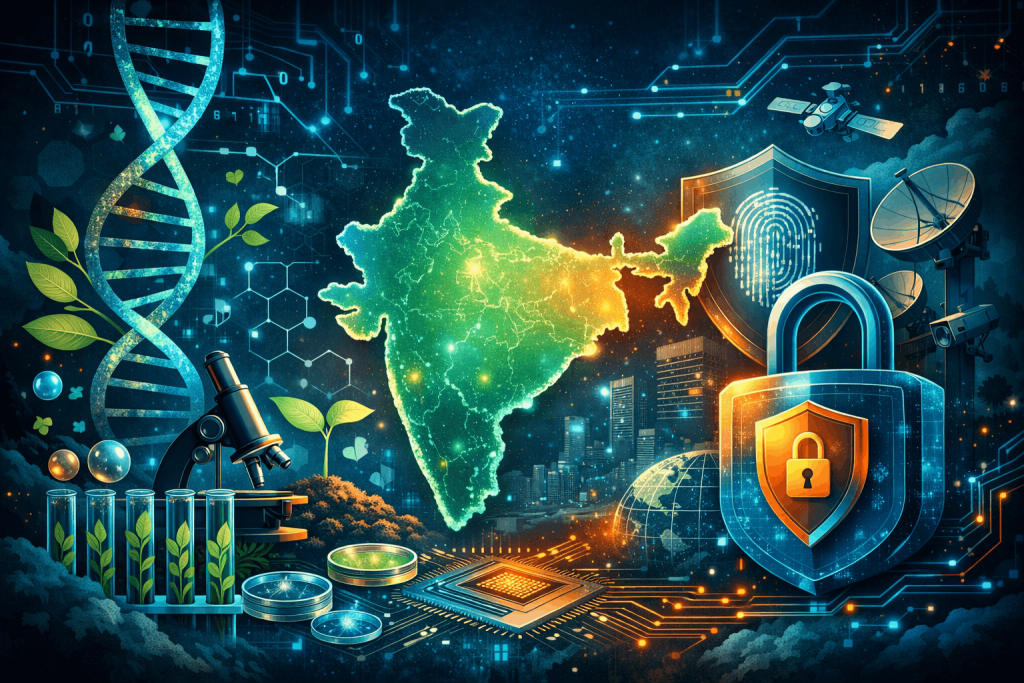
The Bio-Responsibility project involves interdisciplinary research at the intersection of life science, policy and security, along with extensive policy engagement and a training programme to help build national capacity against the mentioned biothreats.
Objectives:
i) To help build national capacity to counter emerging biological threats through policy research, training and engagement.
ii) To conduct evidence-driven policy research and to advocate and inform a comprehensive biosecurity discourse in India.
iii) To build a community of biosecurity professionals and provide a platform to mainstream the Indian policy discourse on emerging biological threats nationally and internationally.
Theory of Change:
The project assumes that strengthening India’s governance and expertise on emerging biological threats will reduce national and global biosafety and biosecurity risks. By combining research, training, and engagement, it will create a sustainable foundation for responsible innovation in life sciences. Specifically:
- If targeted policy research identifies actionable gaps in emerging biothreat areas,
- If early-career professionals are trained to understand and address these risks through a structured training programme,
- If research findings are translated into policy dialogues and engagements with key government and industry stakeholders,
→ then India will develop the institutional/human resource capacity, professional expertise, and policy infrastructure needed to prevent and respond to emerging biological threats — thereby strengthening global resilience against biothreats.
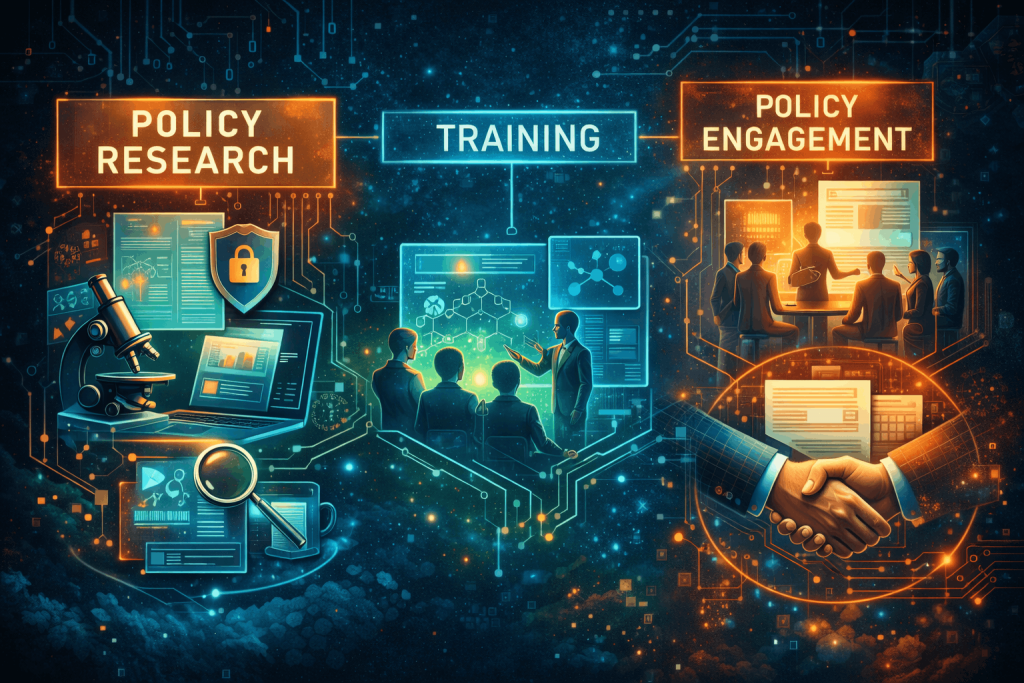
Three major components of this project are listed below:
Policy Research: The Bio-Responsibility policy research involves qualitative and quantitative analysis through a combination of scientometrics, surveys, interviews, workshops and focused group discussions with key stakeholders to co-develop policy solutions. The major questions investigated with the policy research are listed below:
- What are the emerging challenges for biological safety and security in India due to advancements in technologies such as AI and synthetic biology?
- What are the major policy and governance gaps in biosafety, biosecurity and responsible research and innovation in life sciences?
- What technical and policy solutions does India need to develop in the context of global technological, security, policy and regulatory landscapes?
- How could the existing mechanisms, such as the National One Health Mission and Institutional Biological Safety Committees, be leveraged and strengthened to enhance biological safety and security in the country?
Training: The project will initiate a part-time, annual annual training programme designed to strengthen national capacity on responsible research and innovation related to biosecurity, biosafety, and bioethics. It will combine in-person workshops, high-level national and international roundtables, and a series of virtual engagements to expose fellows to both technical and policy perspectives, while enabling direct interaction with experts and policymakers. Fellows will be supported to develop and publish policy briefs as tangible program outputs and will be trained on emerging issues such as AI–bio convergence, synthetic biology, cyber-biosecurity, and other biothreats. Over time, the program aims to build a sustained community of practice through alumni engagement, mentorship, and shared resources, contributing to a growing network of professionals equipped to inform and shape evidence-based policy in this domain.
Policy Engagement: The policy research and training is complemented with engagement efforts through continuous engagement with policymakers, social media outreach and publication of op-eds and popular articles in the media. High-level policy roundtables involving key stakeholders are organized to deliberate on the most crucial issues and co-develop policy solutions. The stakeholders engaged in this effort include officials from relevant government agencies and representatives from industry and innovation promotion bodies.
Publications
- Sarawagi, T. and Namdeo, S.K. Jan 8, 2026. The Evolving Paradigm of AI-Biosecurity: Challenges and Solutions. Centre for National Security Studies (CNSS), Bengaluru. https://cnss.org.in/the-evolving-paradigm-of-ai-biosecurity-challenges-and-solutions/
- Namdeo, S.K. and Chandan, G.N., 2025. Scientometric Analysis of Research on Deliberate Biosecurity Threats Reveals North-Transatlantic Dominance. Journal of Biosafety and Biosecurity. https://doi.org/10.1016/j.jobb.2025.04.002
- Thorat, K. and Namdeo, S.K., 2025. ‘Securing the Life Sciences: The Role of Biosafety and Biosecurity in the Biological Weapons Convention’ in A. Lele (ed), 50 YEARS OF THE BIOLOGICAL WEAPONS CONVENTION: Tracking the Journey, Pentagon Press, Chapter 10. https://idsa.in/publisher/book/50-years-of-the-biological-weapons-convention-tracking-the-journey
- Namdeo, S.K. and Friedman, S.M., 2025. Deliberate Biological Threats in India: Existing Risks and National Capacity for Prevention and Mitigation. Report Submitted to Centre for National Security Studies (CNSS), RUAS Bengaluru.
- Namdeo, S.K. and Zhang, J.Y., 2024. Rethinking science diplomacy and global biosecurity: challenges, emerging practices and the way forward. International Affairs, 100(6), pp.2623-2635. https://doi.org/10.1093/ia/iiae187
- Namdeo, S.K. and Dhar, P. Aug 12, 2024. Emerging biosecurity threats in the age of AI. IndiaBioscience. https://indiabioscience.org/columns/indian-scenario/emerging-biosecurity-threats-in-the-age-of-ai#
- Namdeo, S.K. 2023. Multi-stakeholder Engagement Strategy to Strengthen the Biological Weapons Convention. Strategy Document submitted to the United Nations Office for Disarmament Affairs (UNODA).
- Namdeo, S.K., 2023. Science and Technology Developments: Benefits and Risks for the Biological Weapons Convention. United Nations. ISBN (PDF): 9789211068146. https://doi.org/10.18356/9789211068146
- Namdeo, S.K. Aug 7, 2023. Emerging biological risks: The shadow side of technological progress. IndiaBioscience. https://indiabioscience.org/columns/indian-scenario/emerging-biological-risks-the-shadow-side-of-technological-progres
- Namdeo, S.K. Science and Technology Advancements and Biosecurity: New Horizons. Journal on Chemical and Biological Weapons, Volume 15, ISSN: 0974-0619. https://www.idsa.in/system/files/page/2015/cbw-winter-jul-dec-2022.pdf
- Namdeo, S.K. Mar 26, 2022. Why India Needs a National Biosecurity Policy. The Wire Science. https://science.thewire.in/the-sciences/india-needs-national-biosecurity-policy-leadership-biological-weapons-convention/
- Namdeo, S.K. 2021. (Invited Book Review) ‘Barefoot Global Health Diplomacy: Field Experiences in International Relations, Security, and Epidemics’ by Sebastian Kevany. Current Science, Vol 121, No. 7